
By Alfredo Espinola
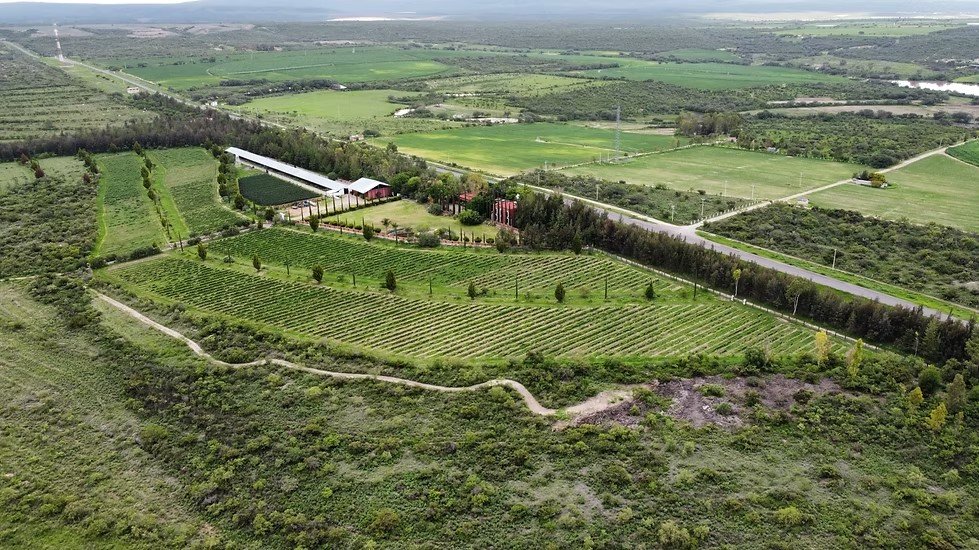
In the heart of the Altos de Jalisco region, where corn was historically grown to feed livestock, vines are now sprouting that tell a different story. Altos Norte Vinícola is the first vineyard and winery in Jalisco to be certified organic in Mexico and the United States, a project that honors the land and boldly challenges tradition.
Located on the Hacienda San José del Tepozán, in Encarnación de Díaz, between San Juan de los Lagos and Lagos de Moreno, this vineyard takes its name from the region that saw its birth: the Altos Norte. A name that also implies a responsibility: to authentically express the character of Jalisco in every bottle.
A passion that germinated in 2016
From a passion for wine and a love for the land inherited from their ancestors, José Vega Villalobos and Karim Hernández founded the vineyard in 2016. They started with half a hectare of Tempranillo and Cabernet Sauvignon; three years later, they added three and a half hectares of Albariño and Malbec. Today, there are four hectares planted with French Mercier and Richter vines, cultivated under a philosophy of deep respect for the environment.
The project is part of an agroecological vision that began in 1994, when the restoration of the property began under an agro-silvo-pastoral model. Since then, consistency has been the focus: regenerative viticulture, living soils, zero herbicides, zero synthetic products. The vineyard is advised by Branko Pjanic of Cava Garambullo.
Live wines, without makeup
At Altos Norte, intervention is minimal and trust in nature is absolute. Fermentation is spontaneous, thanks to the wild yeasts present in the vineyard. The wines are not filtered, clarified, stabilized, or sulfited. Nothing is added, nothing is taken away.
The alkaline soil and climatic conditions of the region have proved ideal for the production of sparkling wines, a style in which the winery specializes.
Zafado: the pride of daring
They named their ancestral method Pet Nat wines ZAFADO. The name comes from a family anecdote: an uncle called José Miguel “zafado” (a little crazy) when he decided to plant vines on a ranch historically dedicated to corn. For saying he would make wine. For imagining sparkling wines in a land that no one associated with bubbles.
Today, ZAFADO is a manifesto: you have to be a little crazy to pursue your dreams.
It is produced in three versions:
- Zafado Rosé (Tempranillo and Malbec)
- Zafado Orange (Albariño)
- Zafado Red (Cabernet Sauvignon and Malbec)
Each harvest is decided based on ripeness and acidity: the wine does not respond to a commercial calendar, but to the pulse of the year. José Vega Villalobos, a civil engineer by training, an oenologist by vocation and self-taught discipline, with studies at the EVA (Escuela de Vino del Altiplano), interprets the harvest as one who translates an ancient language.
Bruto: purity as a banner
If ZAFADO is impulse, BRUTO is restraint.
Traditional method sparkling wines, with a second fermentation in the bottle, which take their name as a metaphor: bruto is not rough, it is the essential before the polished.
Three editions have been produced:
· Bruto Tempranillo 2021
Gold Medal at Mexico Selection by Concours Mondial de Bruxelles, held in Parras, Coahuila (2022). It was the first gold medal for a Jalisco wine in the competition.
· Bruto Albariño 2022
Grand Gold Medal and Sparkling Revelation at Mexico Selection by Concours Mondial de Bruxelles, Yucatan 2023. A historic recognition for the first Albariño harvest from the vineyard
· Bruto Cero (2024)
Traditional Albariño method, Brut Nature, zero residual sugars and zero dosage. Currently on the market, even featured on Quintonil's tasting menu.
Each bottle undergoes two fermentations, but with a single intention: purity.
From university to their own winery
The first still wines (2018-2020) were made at the Value Center of the Technological University of Northern Aguascalientes. Starting in 2021, winemaking moved to their own winery in Jalisco, where they began producing sparkling wines with spontaneous fermentations.
In 2025, they broadened their horizons with an apple cider made using traditional methods, in collaboration with an organic producer near Cofre de Perote.
Conscious growth
They currently produce around 7,000 bottles per year, with a goal of reaching 18,000 in the next three years. They export to the United States and are part of the Mexican Wine Council, the Association of Winegrowers of the Altos de Jalisco (where José Vega is president), and the Regenerative Viticulture Association, with a view to obtaining RVA (Regenerative Viticulture Alliance) certification.
The land as a legacy
Altos Norte is not just a winery: it is an act of consistency. In an increasingly degraded world, its commitment is clear: to give back to the land what it gives. They work with living soils that provide microbiological richness to the grapes and a sense of place to the wines.
Looking to the future, the dream is to consolidate the Altos de Jalisco Wine Route and show the world the cultural tradition and enogastronomic potential of the state.
Because yes, you have to be a little crazy to plant vineyards where there used to be only corn. But you also need vision to turn that daring into history.