
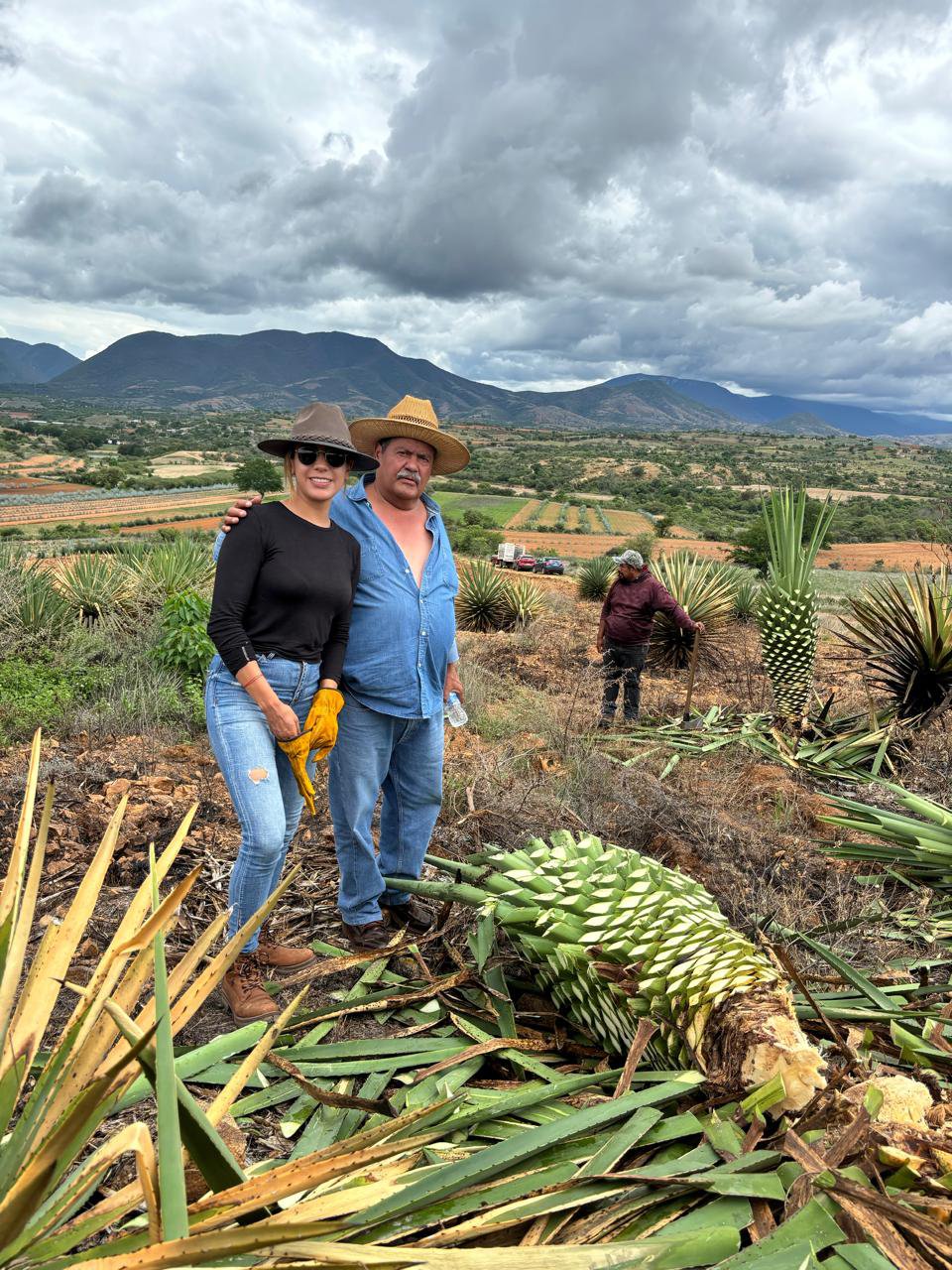
Susana González Moreno and her father, Anastasio Cruz González Pedroso
By Alfredo Espinola
In the heart of the State of Mexico, among maguey plants that open like green crowns toward the sun, Susana González Moreno decided to revive a family tradition that had been dormant between memory and the countryside. Founder of Hacienda de las Verdes Matas, Susana is the creator of Alma de Cruz, a pulque distillate that embodies both the history of her lineage and the desire to reclaim a drink that for centuries has been a symbol of Mexican identity and resistance.
The story of Alma de Cruz began in the 1960s, when Susana's grandfather distributed pulque in Mexico City. His father, Anastasio Cruz González Pedroso, inherited this trade and learned the art of the “chiquera,” the craft of the tlachiquero, and a deep respect for the land from a young age. “My dad continued to plant agave out of love for the countryside,” recalls Susana. “He never thought about it as a business, but one day we looked around and saw that he had a million plants. That's how the idea of giving them a new life was born.”
That new life took shape just two years ago, when the family decided to transform pulque, a living and fragile drink that ferments in a matter of hours, into a distillate with a soul of origin. “We wanted pulque to survive, to be attractive to new generations,” she explains. “For a long time, it has been associated with the lower classes, with the working class, but pulque is our ancient drink, the drink of the gods. Pulque distillate is a way of honoring those roots and carrying them into the future.”
Between the maguey and memory
The production of pulque, mastered for generations, was complemented by a process of research to learn the art of distillation. Susana trained as a mezcal master at the Mexican Institute of Artisanal Distillation (INDA), with the aim of understanding how to transform an ancestral drink into a contemporary distillate.
But the road was not easy. “The biggest challenge has been to break the stigma of the word pulque,” she admits. “Many people associate it with something viscous or with an unpleasant smell, when in reality it is one of the cleanest drinks that exists. Its fermentation requires care, hygiene, and a deep knowledge of agave.”
The other challenge has been the countryside. “Fewer and fewer people want to work the land,” he says with a certain nostalgia. “Country life is hard, poorly paid, and requires a strength that few are willing to give. But our project also seeks that; that if we do well, the people of the countryside, the tlachiqueros, those who still know how to extract the aguamiel, will do well.”
A new generation of pulque

Alma de Cruz is presented as a line of spirits with different alcohol contents, 35%, 40%, 45%, and 50%, designed for both mixology and pure tasting. “The 35% is ideal for cocktails,” explains Susana. “The others are to be enjoyed on their own, slowly, like a good tequila or mezcal.”
Her commitment to mixology is strategic. “The new generations no longer drink as they used to,” she says. “But pulque distillate has smooth notes, without the smokiness of mezcal, which makes it perfect for mixing. It's a way to get in through curiosity and stay for the history.”
And that history is not only told in glasses. Each bottle carries with it a rural heritage, a chain of care that begins with the maguey and ends with the still. “My dad takes care of each plant as if it were part of the family,” says Susana. “He cleans, scrapes, and checks the pulque every day. It's a labor of love. And you can feel that in every sip.”
The soul of agave
At Hacienda de las Verdes Matas, agave salmiana grows organically, without mass explosion. “Pulque distillate cannot be industrialized like tequila,” explains Susana. “Our process remains ancestral; the tlachiquero has to scrape the plant by hand, and that makes production limited, controlled, sustainable.”
That balance between tradition and innovation is at the heart of Alma de Cruz. “It's not about producing for the sake of producing,” she emphasizes. “We want to preserve the essence of the countryside, the craft, the respect for the land.”
In her presentations to customers and restaurateurs, Susana usually begins with an invitation: to smell the distillate. “People are surprised to recognize the notes of pulque,” she says. “Then we show them the pulque itself, so they understand that this comes from something alive.”
Cultural rescue and future
The creation of Alma de Cruz not only seeks to position a new Mexican distillate, but also to restore pulque to the place it lost in the national imagination. “Pulque has been a punished drink over time,” Susana reflects. “From the arrival of the Spanish, who brought wine, to the era of Porfirio Díaz, who considered it vulgar, and later the emergence of beer, which almost completely displaced it.”
Today, however, she senses a change. “The younger generations are returning to what is natural, organic, and ours. I believe that pulque can once again occupy the stellar place it once had. But we must educate, tell its story, and show its cultural and gastronomic value.”
That work of dissemination, he says, now falls to young producers, willing to modernize the tradition without losing its essence. “My dad believed that the most you could do with pulque was bottle it. When I told him about the distillate, he was surprised. But in the end, he understood that we were just giving the soul of pulque another form.”
The drink with soul
In its name, Alma de Cruz pays double homage: to the family lineage and to the spirit of agave. It is a project that unites generations, a bridge between history and the future. “Our dream is not just to sell a drink,” says Susana. “It is for people to feel pride again in pulque, in the countryside, in our roots.”
Each bottle contains the memory of a craft, the echo of the tlachiqueros who scrape the maguey at dawn to extract the aguamiel. In each sip, the soul of a tradition that refuses to disappear.
Because pulque, like the countryside, is still alive. And in Alma de Cruz, it breathes with renewed strength.